AI Images vs. Free Stock Photos: What’s Better for Your Blog in 2024?
Running multiple AI-automated content channels from my base here in Seoul, whether they’re blogs for ‘AI Tools for Solo’ or my YouTube channels, one thing is crystal clear: visuals are non-negotiable. They grab attention, break up text, and convey complex ideas instantly. But for us solo creators and small business owners, the question always comes down to efficiency, cost, and impact. Do you lean on the vast libraries of free stock photos, or do you invest in the cutting-edge capabilities of AI image generators?
This isn’t just a theoretical debate for me. Every single image on my blogs and in my YouTube thumbnails directly impacts my engagement and brand identity. I’ve spent countless hours experimenting, integrating, and even making mistakes with both approaches. In this guide, I’ll share my firsthand experience, breaking down the pros and cons of AI images versus stock photos so you can make an informed decision for your own content.
The Great Visual Showdown: Stock Photos vs. AI Images
Let’s dive into the core aspects that matter most to a solo entrepreneur.
Cost: Free vs. Subscription vs. Opportunity Cost
Free Stock Photos: The Zero-Budget Hero (with caveats)
For a long time, free stock photo sites like Unsplash, Pexels, and Pixabay were my go-to. They offer millions of high-quality images at absolutely no direct monetary cost. This is fantastic when you’re just starting out or working on a tight budget. You can find beautiful landscapes, diverse people, and generic concept shots with a quick search.
- Pros: Absolutely free, generally high-quality photography, massive libraries.
- Cons: Limited uniqueness (everyone uses them), specific concepts are hard to find, licensing can be confusing (always check Creative Commons or specific license for attribution requirements). The mistake I made early on was assuming ‘free’ meant ‘no strings attached’ – sometimes attribution is still required, or commercial use might have restrictions.
Paid Stock Photos: Professional Quality, Higher Price Tag
Services like Shutterstock, Adobe Stock, or Getty Images offer even larger, more curated libraries with professional-grade content. They often have better search functionality and a wider range of styles.
- Pros: Extremely high quality, professional variety, often clearer licensing.
- Cons: Can be expensive, especially if you need many images. Subscriptions can run anywhere from a few dollars to hundreds per month, depending on usage.
AI-Generated Images: Investment for Infinite Possibilities
AI image generators like Midjourney, DALL-E (often integrated into ChatGPT and other platforms), Stable Diffusion variants, or Leonardo AI have a different cost structure. Many offer free tiers for limited use (e.g., a few dozen generations), but for serious, commercial output, you’ll need a paid subscription.
- Pros: Potentially infinite unique images once you master prompting. No per-image cost within your subscription limits. Can be incredibly cost-effective at scale.
- Cons: Requires a subscription (paid plans for Midjourney or DALL-E via OpenAI/Microsoft services often start in the $10-30/month range for commercial usage; always check their official pricing pages for current rates as they change frequently). There’s an upfront time cost to learn prompting.
My take on cost: For initial projects, free stock photos are an excellent entry point. But when I set up my automated YouTube channels and blogs, the per-image cost of paid stock became prohibitive. AI, despite its subscription fee, offers unparalleled cost efficiency at scale once you factor in the sheer volume of unique, tailored visuals you can produce.
Uniqueness & Brand Identity: Standing Out or Blending In?
Stock Photos: The Common Visual Language
The biggest challenge with free stock photos is their ubiquity. How many times have you seen the same ‘person smiling at a laptop’ or ‘group of diverse professionals in a meeting’ image across different websites? It’s hard to build a distinctive visual brand when you’re using the same images as thousands of other creators.
- Pros: Instantly recognizable concepts, often professional aesthetic.
- Cons: Lacks uniqueness, can dilute brand identity, hard to find very specific niche concepts.
AI Images: Your Visual Fingerprint
This is where AI truly shines for me. With a carefully crafted prompt, I can generate images that are 100% unique to my brand. For example, for ‘AI Tools for Solo,’ I can specify a consistent aesthetic: minimal, futuristic, with specific color palettes and even subjects (e.g., a robot hand interacting with a keyboard, but always in a specific art style). This allows me to create a cohesive visual language across my blog posts and my YouTube channel thumbnails.
- Pros: Unparalleled uniqueness, perfect brand alignment, can visualize abstract or very niche concepts.
- Cons: Requires effort to maintain consistency (e.g., using seed numbers or character reference features in Midjourney), initial learning curve for prompt engineering.
My experience: The ability to create ‘my own’ stock photos is a game-changer for brand building. My audiences quickly recognize the visual style, which helps in a crowded content landscape.
Time & Efficiency: Search vs. Create
Stock Photos: The Hunt for the Right Image
Searching for stock photos can be a mixed bag. Sometimes, a quick keyword search yields exactly what you need. Other times, especially for more niche or specific concepts, you can spend hours sifting through irrelevant results. Licensing checks also add to the time investment.
- Pros: For common concepts, it can be very fast to find a suitable image.
- Cons: Time-consuming for niche concepts, endless scrolling, often requires compromise if the perfect image isn’t available.
AI Images: Prompting for Perfection
Initially, learning to prompt effectively with tools like Midjourney or DALL-E takes time. It’s an art and a science. But once you get the hang of it, generating variations or entirely new images for a specific concept can be incredibly fast. For my automated content pipelines, I use tools like Make (formerly Integromat) or n8n to connect my content generation (from ChatGPT or Claude) to image generation. My content outlines often include image prompts, which are then automatically fed to the AI image generator.
- Pros: Rapid iteration once proficient, ability to generate many variations quickly, automation potential for large-scale content production.
- Cons: Steep initial learning curve for effective prompting, occasional ‘weird’ results that need refinement.
My process: I’ve built flows where a blog post draft is reviewed, and suggested image prompts are automatically sent to Midjourney. The generated images are then presented for selection or slight re-prompting. This level of automation is impossible with traditional stock photos and is crucial for running multiple channels.
Quality & Consistency: Polished Photography vs. Evolving AI Art
Stock Photos: The Gold Standard of Photography
Stock photos, especially paid ones, generally represent professional photography at its best. They are crisp, well-composed, and often meticulously edited. Consistency, however, depends on finding images within the same stylistic family or from the same photographer.
- Pros: Consistently high photographic quality, realistic depictions.
- Cons: Stylistic consistency can be challenging across a large body of work unless you meticulously curate from specific sources.
AI Images: Rapidly Improving, Still Imperfect
The quality of AI-generated images has improved exponentially in the last couple of years. Modern tools can produce stunning, photorealistic, or highly artistic images. However, they still have quirks. Hands, text within images, and very specific anatomical details can sometimes look off. Achieving consistent character appearance across multiple images is getting easier (e.g., Midjourney’s --cref feature), but it’s not foolproof.
- Pros: Amazing artistic range, often indistinguishable from human-created art in many styles. Rapid advancements mean quality is constantly improving.
- Cons: Can still produce artifacts (especially hands, text), achieving absolute realism or perfect consistency for very specific elements requires careful prompting and iteration.
Honest limitation: I can tell you that I’ve spent a fair bit of time regenerating images because a character had six fingers or the text was just gibberish. It’s getting better, but it’s not ‘set it and forget it’ for perfectionists. You need to be prepared to refine your prompts and regenerate.
Licensing & Usage Rights: Navigating the Legal Landscape
Stock Photos: Varied and Complex
Stock photo licensing is a minefield if you’re not careful. Creative Commons licenses can range from ‘use freely with attribution’ to ‘non-commercial use only.’ Paid stock often comes with ‘standard’ or ‘extended’ licenses, with different rights for print, merchandise, or large-scale advertising. Always, always read the fine print.
- Pros: Established legal frameworks.
- Cons: Can be confusing, requires careful attention to avoid copyright infringement.
AI Images: Evolving and Specific
The legal landscape for AI-generated images is newer and still evolving, but generally, with paid subscriptions to tools like Midjourney or DALL-E, you retain commercial usage rights for the images you generate. However, it’s crucial to check the specific terms of service for each tool, as they can differ. Some tools might have restrictions on generating certain types of content or on using the output for specific purposes.
- Pros: Generally clear commercial use rights with paid subscriptions.
- Cons: Legal landscape is still new, terms can vary widely between providers, and you must review each tool’s specific policies.
My Take: A Hybrid Approach for Solo Creators
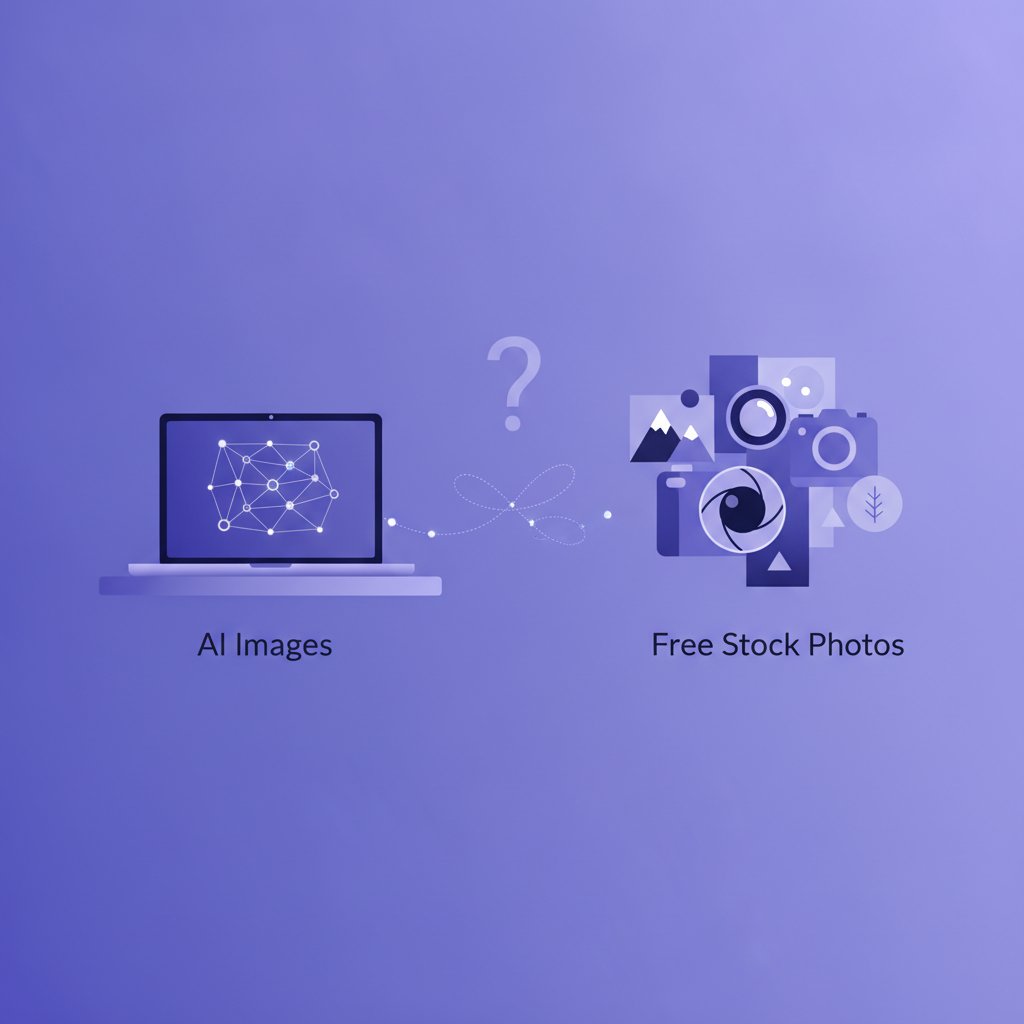
After running my content factories with both free stock photos and AI-generated images, my honest recommendation for solo creators is not an either/or, but a hybrid approach. There’s no single ‘better’ option; it truly depends on your specific needs, budget, and where you are in your content journey.
- Just starting out? Free stock photo sites like Unsplash are an excellent way to get high-quality visuals without any upfront cost. They’re perfect for general blog posts, social media updates, and getting a feel for what visuals resonate with your audience.
- Ready to scale and build a unique brand? Invest in an AI image generator. For ‘AI Tools for Solo’, I heavily rely on AI for my hero images, custom illustrations, and YouTube thumbnails. The ability to create perfectly tailored, unique visuals at scale is invaluable for my brand consistency and efficiency, especially when combined with automation tools like Zapier or Make. Yes, there’s a learning curve and a subscription cost, but the ROI in terms of brand differentiation and production speed is immense.
- Best of both worlds: Use free stock photos for generic, less critical visuals (e.g., a simple background, a placeholder). Reserve your AI image generation for key visuals: your blog’s featured images, custom illustrations for complex concepts, unique banners, and anything that needs to be perfectly on-brand.
The mistake I see many new creators make is either sticking too long with generic stock photos, thus blending in, or diving into AI without understanding the prompting nuances, leading to frustration. Start simple, experiment, and gradually integrate AI as your content needs grow more sophisticated. Always check the official pricing pages and terms of service for any tool you consider, as features and policies are constantly evolving.
FAQ: AI Images vs. Stock Photos
Can I use AI-generated images for commercial purposes?
Generally, yes, if you are using a paid subscription to a reputable AI image generator like Midjourney, DALL-E (via OpenAI or Microsoft), or Leonardo AI. These services typically grant commercial usage rights for content created on their paid plans. However, it is absolutely critical to review the specific terms of service for the tool you are using, as policies can vary and are subject to change.
Is it hard to learn how to use AI image generators effectively?
There is definitely a learning curve, often referred to as ‘prompt engineering.’ Initially, you might struggle to get the exact results you envision. However, many tools are becoming increasingly user-friendly, and there are tons of tutorials and communities (like Midjourney’s Discord server) that can help you learn quickly. Start with simple prompts and gradually add detail. The key is iteration and experimentation – you’ll be amazed at what you can create with practice.
Do AI images really look as good as professional stock photos?
For many styles and purposes, yes, AI-generated images can look as good as, or even better than, professional stock photos, especially for conceptual art, illustrations, or highly stylized visuals. For extremely photorealistic images, especially those involving complex human anatomy or very specific real-world scenarios, AI is rapidly improving but can still sometimes produce subtle imperfections. For most blog and online content needs, modern AI tools are more than capable of delivering stunning, high-quality visuals.
Keep Reading
- AI Music Generator Copyright: Rights and Reality for Solo Content Creators
- Text-to-Video AI in 2026: What It Can and Can’t Do Yet for Solo Creators
- CapCut AI for Solo Creators’ YouTube Shorts Workflow
- AI Video Dubbing: Solo Creator’s Guide to Reaching Global YouTube Audiences